
This article was originally published in Technically Speaking (August 2025, CMT Association) and was also featured by Investopedia.
The Need for Market Timing
Market timing is effective because it minimizes drawdowns during market declines. In today’s fast-paced markets, skillful timing is more crucial than ever. From February to June 2025, we have just witnessed the S&P 500’s journey from all-time highs to a drawdown of almost 20% before rebounding again to higher levels—a rollercoaster.
Yet, it remains surprising how many still dismiss market timing altogether.
Detractors frequently cite the familiar “missing the best 20 days” argument, insisting that missing just a handful of top-performing days drastically undermines returns. Their conclusion: stay fully invested, regardless of the conditions.
This argument has been thoroughly disproved. As Ryan Gorman, CMT, Shawn R. Keel, and Vincent Randazzo, CMT noted in the June 2025 issue of Technically Speaking the best days typically cluster near the worst. Enduring a crash exposes portfolios to losses so severe that a handful of strong days cannot compensate. High volatility is not an ally: it’s a threat to long-term returns.
Beyond this, two other fallacies often underpin the buy-and-hold narrative.
The first is that markets always recover over time, so patience will eventually pay off. While this may hold over decades, it’s dangerously misleading for retirees. Most investors save with a finite time horizon, and a major drawdown near retirement can be catastrophic.
Consider a retiree who withdraws 5% of their capital each year. A 50% market decline cuts their savings in half, effectively doubling the withdrawal rate to 10% to maintain their standard of living. Even if they reduce withdrawals to 5%, they still face a total loss of 55%, comprising 50% from market decline and 5% from withdrawals. For retirees, drawdowns are not just inconvenient; they are existential threats. Not all investors can average down or keep contributing. There is a season to reap, and severe drawdowns can ruin that harvest.
The second misconception is the blind faith in U.S. exceptionalism, particularly the notion that American markets will always recover. While I trust the earning power of U.S. companies, hope alone isn’t a strategy. What if the U.S. starts to look like markets in other countries? Many global stock markets have experienced drawdowns so severe that they never fully recovered or took decades to do so, wiping out generations of investors.
For these reasons, market timing isn’t a luxury; it’s a necessity for those trying to prevent the portfolio destruction typical of bear markets. It safeguards both capital and investor psychology, helping avoid capitulation at the very bottom.
Measuring the Power of Timing
To evaluate the benefits of market timing, we compared three timing indicators applied to the S&P 500 against a traditional buy-and-hold strategy:
- The Dow Theory for the 21st Century (DT21C). It’s the venerable, time-tested Dow Theory, which includes the S&P 500.
- The Blay Timing Indicator (BTI) – based on trends and margin debt
- The Composite (Comp)– a signal-based blend of the two above
The Composite is my preferred tool, and the one I use in real-world trading. Like a twin-engine aircraft, it provides a smoother ride: its drawdowns exhibit lower standard deviation than either of its component indicators.
Our study spans from July 6, 1978, to May 2, 2025, utilizing total return data for the S&P 500. When out of equities, the timing models go to cash and earn prevailing T-bill rates. I am deeply grateful to my friend Tom Halgren, a true computer geek in the best sense—meticulous, passionate, and endlessly curious—who performed all calculations using Linux.
Drawdown Reduction
Table 1 displays the maximum drawdowns (Max.DD). The results are striking:
Buy-and-hold endured nearly double the drawdowns experienced under the timing models.
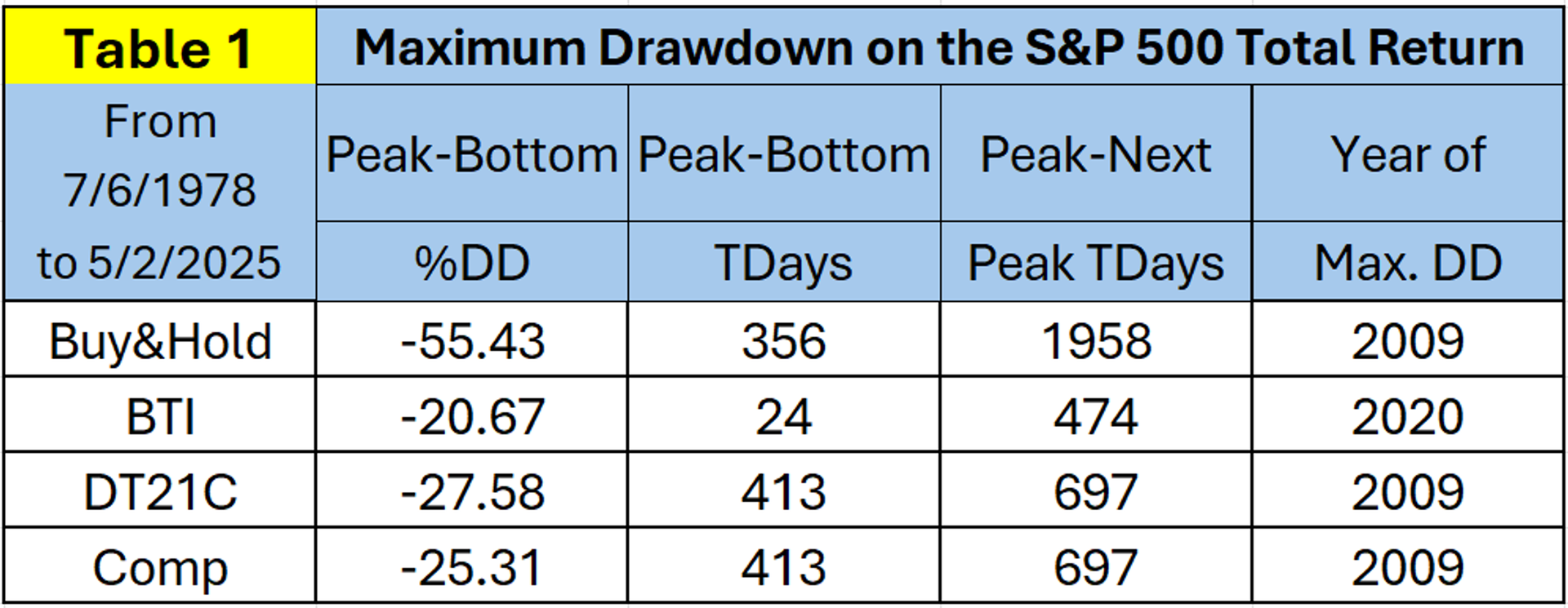
Equally important is the time to recovery. The “Peak-to-Peak TDays” metric indicates how long it took each strategy to recover to its prior equity highs. All timing models more than halved this recovery period.
Therefore, market timing not only minimizes the depth of drawdowns but also shortens their duration. This is especially important for those making regular withdrawals. Ask any retiree: time spent in drawdown can be just as painful as the drawdown itself.
Average Drawdown and Recovery
One might argue that the maximum drawdown encountered in the last 47 years is not so relevant, as it is a “worst-case scenario”. So, let’s focus on the average drawdowns. Does market timing keep its edge?
Yes, as Table 2 indicates:
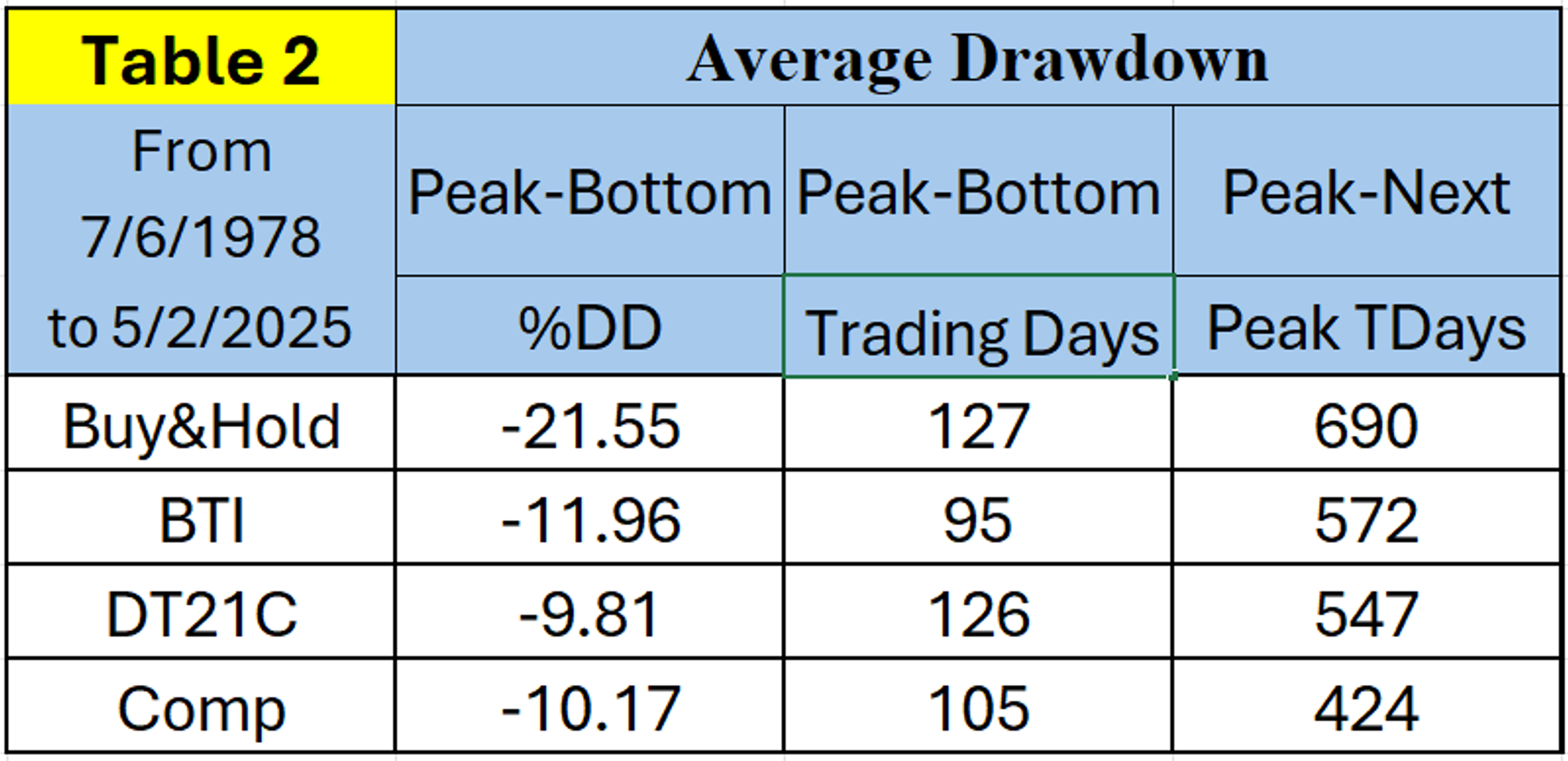
The average drawdown for all three timing indicators is approximately 50% less than that of buy-and-hold. Likewise, the average time required to reach new equity highs is significantly shorter.
Market timing offers tangible improvements in both the severity and duration of declines. These aren’t theoretical advantages; they translate into real-world peace of mind and capital preservation.
Outperformance
Drawdown control is vital, but a good timing strategy should also deliver superior returns. Table 3 shows that all three indicators outperformed buy-and-hold by a wide margin.
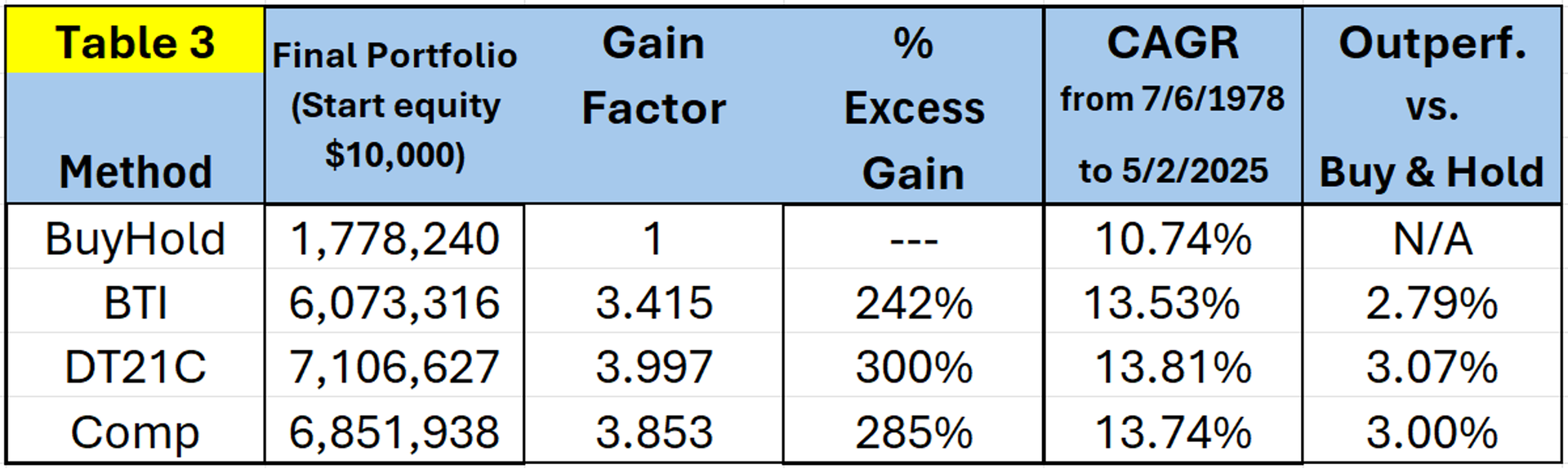
Over the 47 years studied, a $10,000 investment under the timing strategies would have more than tripled the final capital compared to a buy-and-hold strategy.
In annualized terms, market timing added roughly 3% per annum, which is enormous in risk-adjusted terms, as such outperformance is achieved by incurring half the risk of buy-and-hold.
Conclusion
The evidence is clear. Market timing significantly reduces drawdowns, shortens recovery times, and delivers stronger long-term returns than passive investing.
In a world where most investors must eventually draw down their portfolios, often under pressure, timing offers both defense (smaller drawdown) and offense (outperformance).
For those willing to follow a disciplined, rules-based approach, market timing isn’t just an alternative. It’s a superior path forward.
Sincerely,
Manuel Blay
Editor of thedowtheory.com