

Overview: In my June 1st Letter to subscribers, I noted that the two-year Treasury yield was breaking higher and that this would likely exert a negative influence on liquidity.
One of the main casualties appears to have been gold and silver. Today, 6/9/26, a new bear market was signaled in both metals. Gold and silver miners have also been hit, and I will address them in a separate post.
Stocks, by contrast, have been affected only modestly so far. The decline has not even been enough to turn the secondary trend bearish. Therefore, both the primary and secondary trends for stocks remain bullish.
General Remarks:
In this post, I extensively elaborate on the rationale behind employing two alternative definitions to evaluate secondary reactions.
GLD refers to the SPDR® Gold Shares (NYSEArca: GLD®). More information about GLD can be found HERE.
SLV refers to the iShares Silver Trust (NYSEArca: SLV®). More information about SLV can be found HERE.
A) Market situation if one appraises secondary reactions not bound by the three weeks and 1/3 retracement dogma.
As I explained in this post, the primary trend was signaled as bullish on 4/2/24.
Following a pullback (secondary reaction against the bullish trend), both GLD and SLV experienced a bounce, setting up both ETFs for a potential primary bear market. You can find detailed explanations and charts HERE.
The table below gives you all the relevant information:
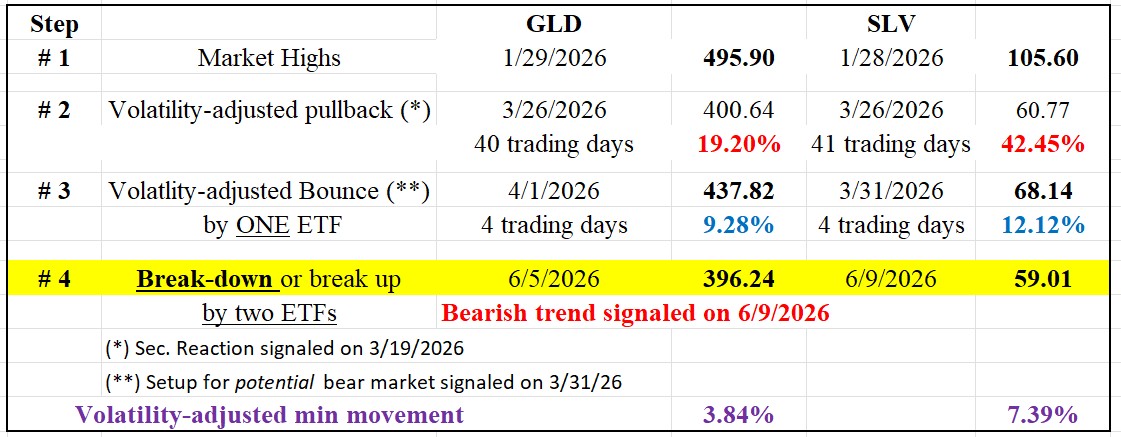
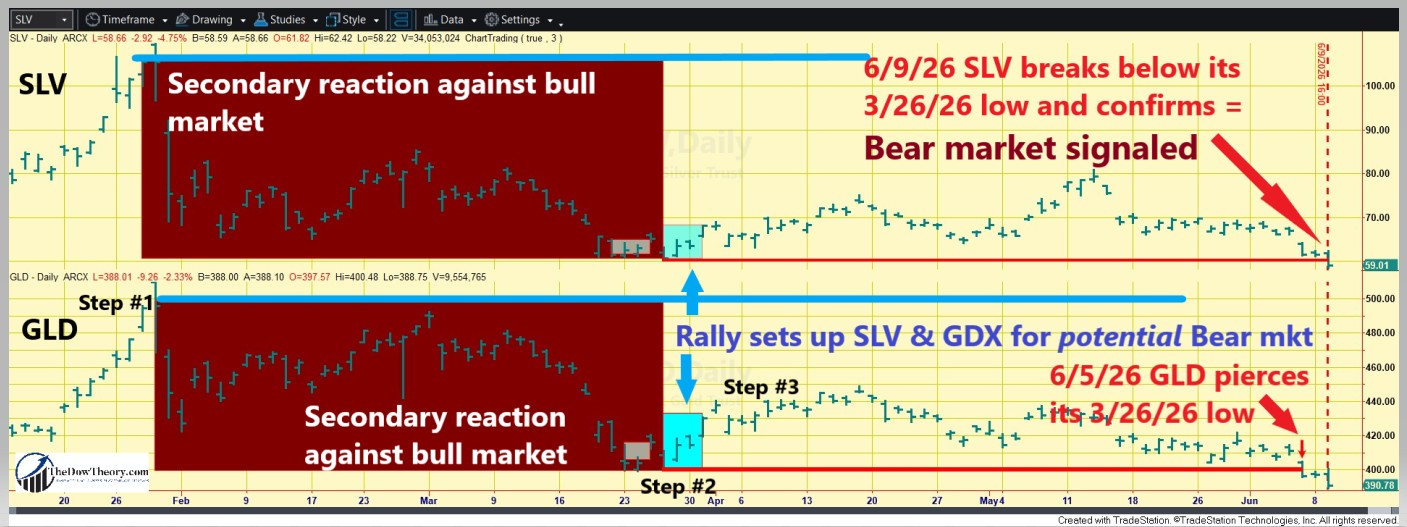
On 6/5/26, GLD broke down below its 3/26/26 pullback lows (Step #2). On 6/9/26, SLV confirmed by piercing its 3/26/26 closing lows. Since it was a confirmed violation, a primary bear market was signaled according to the Dow Theory.
Check out the chart below for a visual walkthrough of the recent price action. The brown rectangles highlight the secondary reaction (Step #2), the blue rectangles show the rally (Step #3) originating from the secondary reaction lows that set up both ETFs for a potential bear market signal, and the red horizontal lines pinpoint the pullback lows whose joint violation signaled the new “bear market.” The blue horizontal lines highlight the last recorded primary bull market highs (Step #1), whose upside breakout would signal a new primary bull market.
Thus, both the primary and secondary trends are currently bearish.
B) Market situation if one sticks to the traditional interpretation demanding more than three weeks and 1/3 confirmed retracement to declare a secondary reaction.
As I explained in this post, the primary trend was signaled as bullish on 4/2/24.
In this instance, the long-term application of the Dow Theory coincides with the shorter-term version, so there was a secondary reaction against the primary bull market, and the setup for a potential bear market signal has been completed. The confirmed violation of the 3/26/26 secondary reaction low triggered a bear market signal.
Thus, both the primary and secondary trends are currently bearish.
Sincerely,
Manuel Blay
Editor of thedowtheory.com