


Once again, the principle of confirmation gave a warning.
Overview: High crude oil prices are finally exerting inflationary pressure. With year-over-year CPI at 3.8%, bond yields have finally succumbed, and a new bear market in bonds, implying higher interest rates, was signaled on 5/19/26
As higher interest rates seem to be fueled by rising inflation rather than by higher real rates linked to stronger productivity, this creates another headwind for stocks. It is not necessarily a harbinger of a bear market, but it may limit their upside.
The principle of confirmation once again saved investors from adding to their position on three upside breakouts by IEF. In the three instances, TLT refused to confirm, making the breakouts suspect. More about how the principle of confirmation can save your skin in this post (and links therein)
General Remarks:
In this post, I extensively elaborate on the rationale behind employing two alternative definitions to evaluate secondary reactions.
TLT refers to the iShares 20+ Year Treasury Bond ETF. You can find more information about it here
IEF refers to the iShares 7-10 Year Treasury Bond ETF. You can find more information about it here.
TLT tracks longer-term US bonds, while IEF tracks intermediate-term US bonds. A bull market in bonds signifies lower interest rates, whereas a bear market in bonds indicates higher interest rates.
A) Market situation if one appraises secondary reactions not bound by the three weeks and 1/3 retracement dogma
As I explained in this post, the trend was signaled as bullish on 4/4/25.
A rally ensued after the 5/21/25 lows (Step #3), which lasted for >=2 days with IEF exceeding its VAMM. Please remember that we don’t require confirmation for the final rally that completes a bear (or bull) signal setup. More information is in this post.
On 9/25/25, IEF surpassed its 4/4/25 bull market highs, unconfirmed by TLT. Again, on 10/22/25, IEF made an unconfirmed higher high.
Finally, on 2/27/26, IEF made an even higher high, while TLT failed even to exceed its previous local highs. A glaring non-confirmation.
Such a non-confirmation is not a bear market signal, but it was a yellow light: the IEF breakouts were suspect and therefore not enough to cancel the secondary (bearish) reaction.
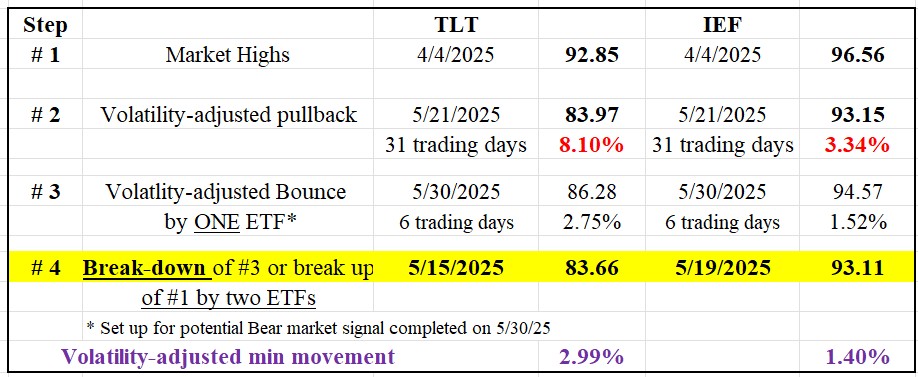
On 5/15/26, TLT violated its 5/21/25 secondary reaction lows. On 5/19/26, IEF confirmed by piercing its 5/21/25 secondary reaction lows. Confirmation means that a new primary bear market in bonds has been signaled.
The table below shows the price action that led to the primary bear market signal:
So, the primary and secondary trends are bearish now.
The following charts depict the latest price movements. Brown rectangles indicate the secondary (bearish) reaction opposing the ongoing primary bull market. Blue rectangles highlight the rally that completed the setup for a potential primary bear market (Step #3). Red horizontal lines mark the secondary reaction lows (Step #2). The blue horizontal lines show the bounce highs (Step #3). A breach of these peaks would signal a new primary bull market, though this scenario appears unlikely in the near term.
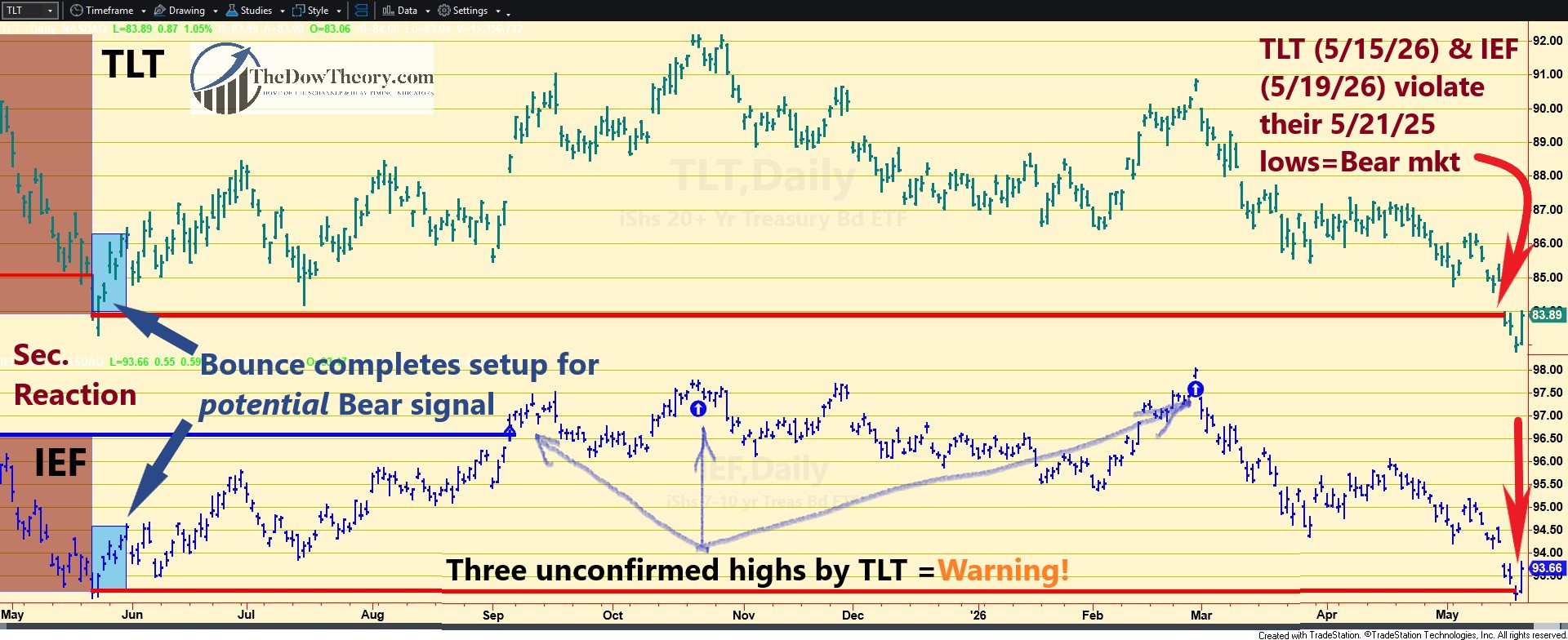
So, the situation is as follows: At the current juncture, a breakout on a closing basis by both TLT and IEF above their 4/4/25 closing highs (Step #1) would signal a new bull market. Until this breakout occurs, we consider bonds to be in a bear market.
B) Market situation if one sticks to the traditional interpretation requiring more than three weeks and 1/3 confirmed retracement to declare a secondary reaction.
As I explained in this post, the primary trend shifted to bullish on 4/4/25.
In this instance, the long-term application of the Dow Theory aligns with the shorter-term version, and hence the primary trend shifted to bearish on 5/19/26
Sincerely,
Manuel Blay
Editor of thedowtheory.com