
A Practical Framework For Managing Risk In Your Portfolio
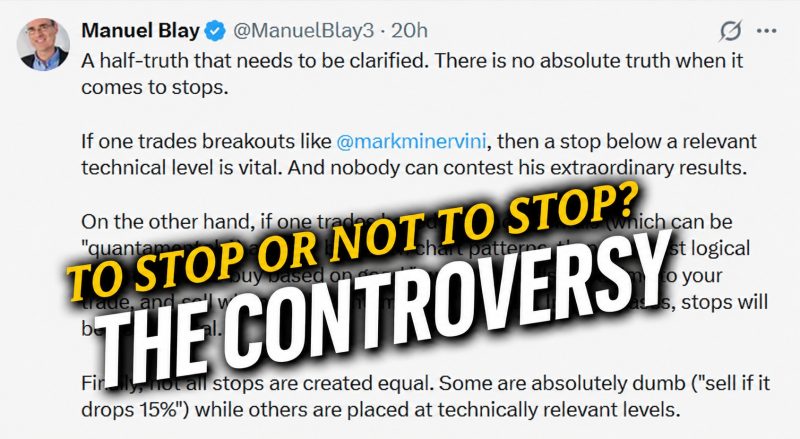
A recent thread on X.com about stop losses turned into a small controversy, as this topic tends to do, because it quickly polarizes people. Here is the link to my post:
https://x.com/ManuelBlay3/status/2085467290200625336
On one side are those who insist you need a stop and that skipping one is simply reckless. On the other are those who consider a stop a tool for people who end up getting run by algorithms and market makers, placed exactly where everyone else’s stop already sits. What follows is a distillation of that back-and-forth, an attempt to bring some clarity to when a stop genuinely makes sense and when it does not, which depends entirely on your personal approach to trading and the strategy you are actually running.
Path One: Protection Through Breadth, Not Through Stop-Loss
If your edge is fundamental, meaning you are buying businesses because of earnings power, balance sheet quality, or a mispriced cash flow stream, a mechanical price stop is often the wrong tool. Fundamentals move slowly. A drawdown in a sound business is frequently noise rather than signal, and a rigid stop turns a temporary markdown into a realized loss right before the thesis has time to play out. The logical alternative is to buy on good fundamentals, give the trade time, and sell only when those fundamentals deteriorate. Applying a price-based stop in that context is not caution; it is self-sabotage.
The protection here comes from position count and position sizing, not from a stop loss rule. A portfolio of twenty stocks or more, reasonably sized and not concentrated in a single sector, already absorbs company-specific risk the way an index does. One name can fall sharply, and the portfolio survives.
This is also the honest answer to the sharpest objection raised in the discussion: whether rejecting stops means accepting a catastrophic loss from a surprise event such as a bad offering or an accounting scandal. It does not, provided the position was sized correctly in the first place. A severe loss on a name that was four or five percent of the portfolio is painful but survivable. A severe loss on a name that was the entire position is a different problem altogether, and no stop loss discussion fixes bad sizing after the fact.
There is a practical problem hiding inside this path, though, and it deserves to be said plainly rather than assumed away. Twenty stocks is the minimum for proper diversification, yet finding twenty genuinely attractive fundamental ideas through discretionary judgment alone is no easy task. How do you consistently decide what is good and what is bad? How much weight should be given to earnings, quality, value, momentum, or any of the other factors that matter? Most investors, working through annual reports, model one company at a time and run out of high conviction ideas well before they reach twenty. Depth of research and breadth of names pull against each other, and something usually gives: either the position count shrinks below what real diversification requires, or the quality of research per name thins out to fill the roster.
But if building a portfolio of twenty high-quality ideas is difficult, deciding when those same twenty stocks should be sold is even more challenging.
Buying is only half the battle. A company rarely goes from attractive to unattractive overnight, and determining when its fundamentals have deteriorated enough to justify a sale is often a matter of judgment rather than a clear-cut decision.
And this is precisely where human nature becomes dangerous.
I was reminded of this while reading the latest “Market Wizards” book. One trait appears again and again among even extraordinarily successful traders: learning to control risk was difficult. It wasn’t simply a matter of knowing that stops or exit rules were necessary. Even when traders had them, the temptation to override them was often there.
I recognize the problem because I experienced it myself. When I started trading, a stock could hit my stop, and I would think: let’s give it a little more room, it will recover. And the dangerous thing is that this often worked, maybe eight times out of ten. But the other two times, the stock didn’t recover. The loss kept compounding and eventually became enormous. Those few disasters could wipe out much of what had been gained from all the occasions when overriding the stop appeared to have been the correct decision.
The problem, therefore, is not merely designing an exit rule. The problem is obeying it.
The solution I have settled on is what I call “quantamentals”. The underlying inputs are still fundamental: growth, value, quality, profitability, earnings revisions, the same building blocks any fundamental investor would recognize, but they are processed on a quantified, computerized basis rather than judged name by name through memory, instinct, and conviction.
This approach solves two problems at once. First, it makes genuine diversification practical. Instead of developing twenty separate high-conviction narratives, the computer evaluates the entire investment universe using the same rules and ranks each stock accordingly. I don’t need twenty compelling stories. I need twenty stocks that objectively score better than the alternatives.
The second advantage may be even more important: quantification imposes discipline on the sell side. Every rebalance produces stocks that deserve to enter the portfolio and stocks that no longer deserve to remain in it. If five better-ranked stocks need to come in, cash must be raised by selling stocks whose rankings have deteriorated. That completely changes the psychology of selling.
There is no “let’s wait another week.”
No “maybe it will come back.”
No emotional attachment to the original thesis.
The rule for selling is not a price level; it is a rank-based exit. A position is sold when its “quantamental profile” deteriorates past a defined threshold, not when the story I originally told myself about the company stops feeling true. That distinction matters more than it sounds. A stock held because of a narrative gets defended long after the evidence has changed, because human beings are remarkably good at finding new reasons to defend an old decision. A stock held because of a quantified score has no story to defend. It has a ranking, and when that ranking deteriorates sufficiently, it goes.
I have come to think of the portfolio almost like the shelves of a supermarket. Shelf space is scarce. If some oranges are deteriorating while fresher, better merchandise is waiting to take their place, the supermarket owner does not become emotionally attached to the old oranges. He clears the shelf and replaces them.
A quantitative portfolio works much the same way. Capital is scarce shelf space. A stock does not need to become a disaster before it deserves to be sold. It merely needs to become less deserving of that scarce capital than the alternatives. This is a subtle but crucial difference: I am not necessarily selling because something terrible has happened to the company or because its price has crossed an arbitrary line, but because better opportunities now exist relative to the rest of the investment universe.
This is why, in a diversified quantitative strategy, risk management does not have to mean placing a mechanical stop beneath every position. Risk is controlled through small position sizes, diversification across sectors, systematic ranking, and the disciplined replacement of deteriorating holdings. The computer does not hope. It does not fall in love with a stock. And, most importantly, it does not second-guess the sell signal.
Jim Simons and Renaissance Technologies built the most successful track record in the industry, largely without discretionary stop-losses on individual positions. Their protection came from an entirely different architecture: thousands of small, statistically independent bets, each with a modest edge, held briefly, sized so that no single position could meaningfully damage the fund, and diversified across so many uncorrelated signals that the portfolio behaved closer to an insurance book than to a stock picker’s book. Risk was managed at the level of the whole system through position sizing, correlation control, and turnover, not at the level of any single trade’s exit price.
But some of you may still think that a stop loss would add an additional layer of protection to an already well-diversified portfolio based on “quantamentals”. I am sorry to disappoint you. The addition of stops to such strategies always results in a sharp degradation of performance.
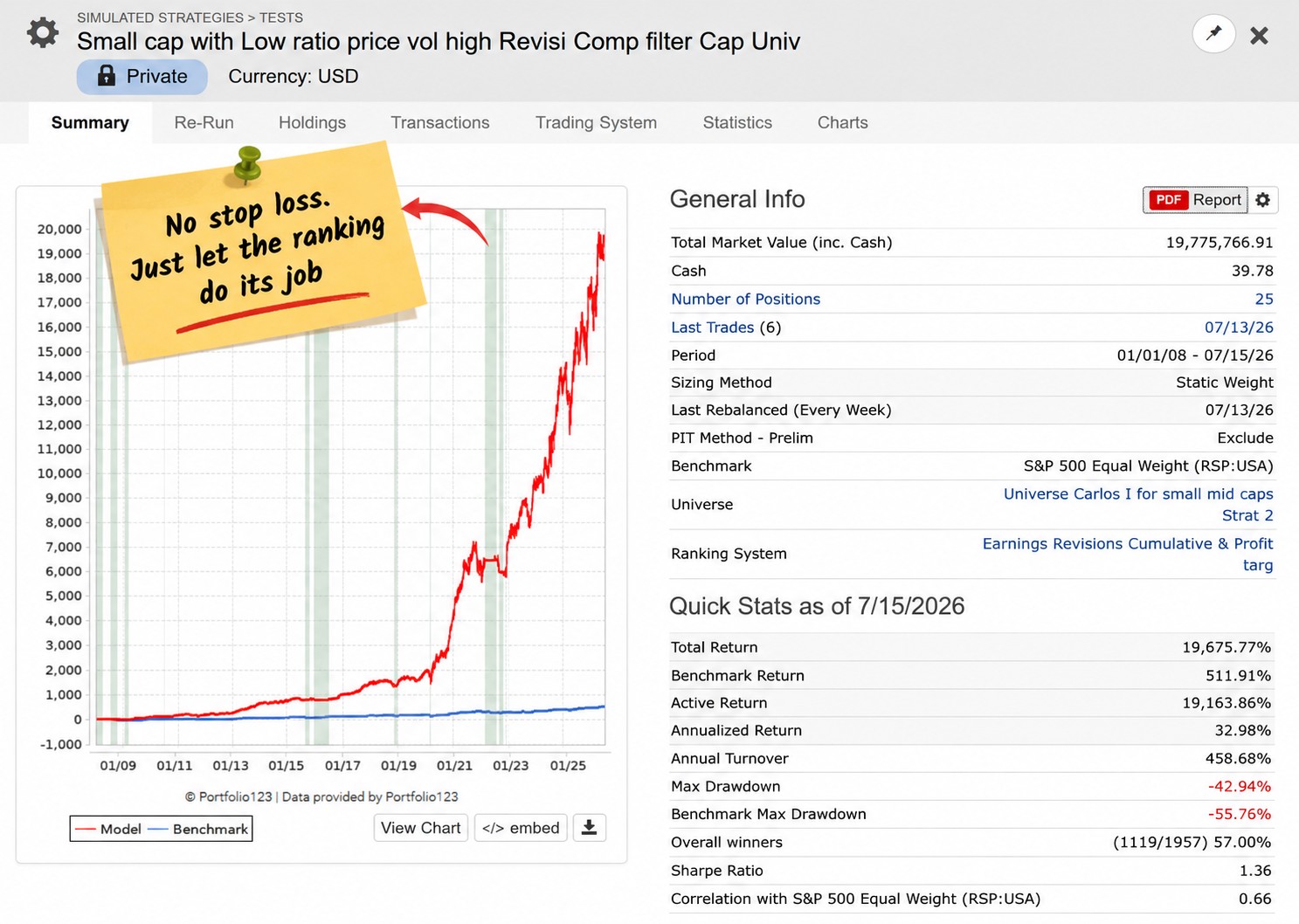
The image below shows one of my quant strategies without a stop-loss. A nice equity curve with an annual performance of 32.98% and a -42% drawdown.
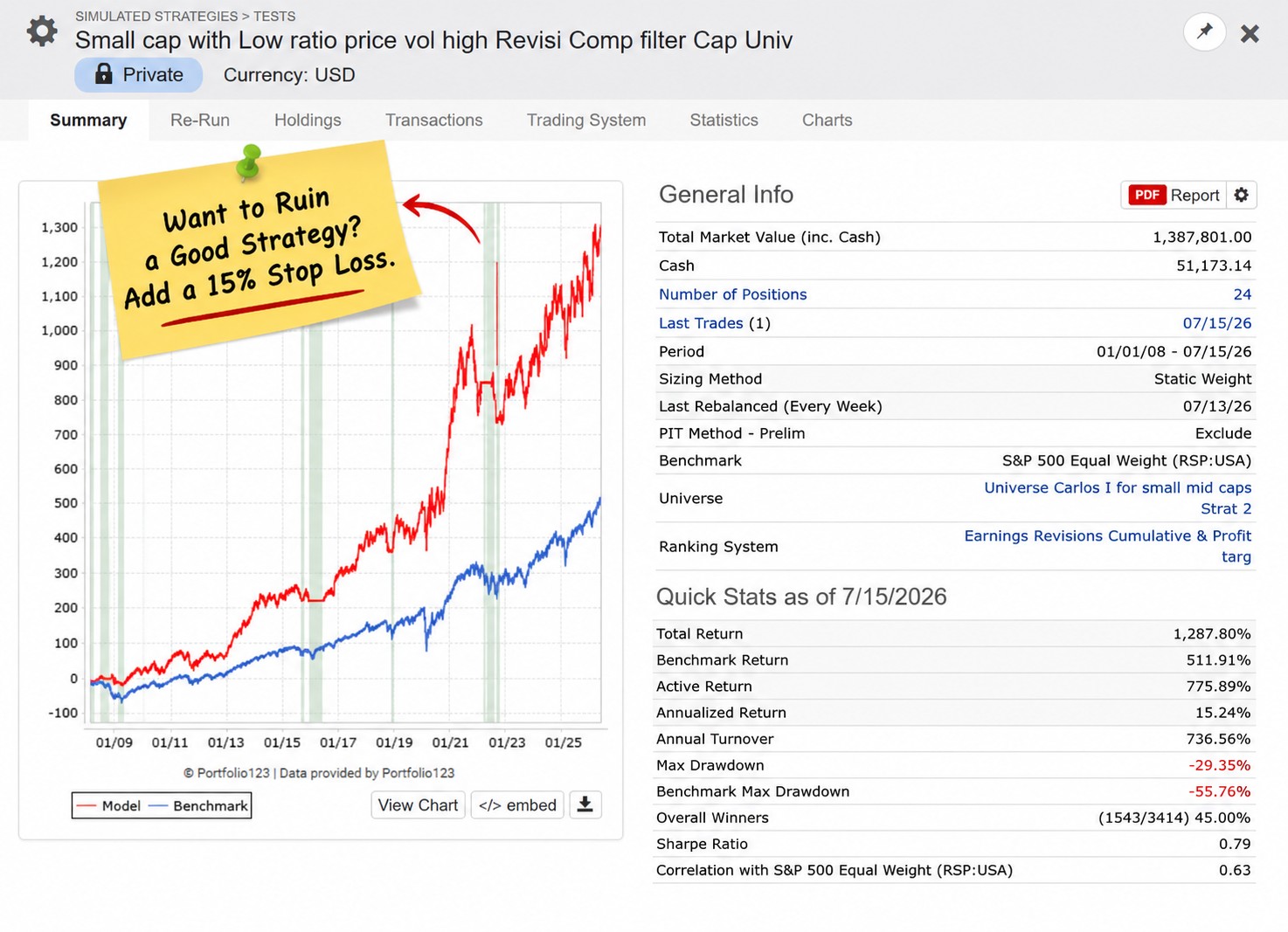
Now, if we add a 15% stop-loss, we effectively ruin the strategy, as the chart below shows. Performance is nearly halved, falling to 15.24%, while the maximum drawdown improves by only 31%, declining to 29.35%. This relatively modest reduction in drawdown comes at far too high a cost in performance.
The deterioration in risk-adjusted returns is equally striking: the Sharpe ratio falls from 1.36 without a stop loss to just 0.79 with the 15% stop.
Furthermore, turnover explodes to 736%, adding substantial transaction costs and slippage and making the strategy extremely difficult to trade in practice.
Therefore, if one invests based on “quantamentals”, one should steer away from using stop-losses.
Path Two: Protection Through The Stop-Loss
If instead your edge is technical, such as buying breakouts, moving-average crossovers, price patterns, or swing trading, and, to make things worse, you have few positions open at the same time, a stop is not optional. Furthermore, such “technical” traders tend to have a very concentrated portfolio, often with fewer than 5 positions. In such a case, a stop-loss is a vital tool for survival.
But not all stops are equal, and this is where many traders get it wrong. There are dummy stops and intelligent stops.
Dummy stops
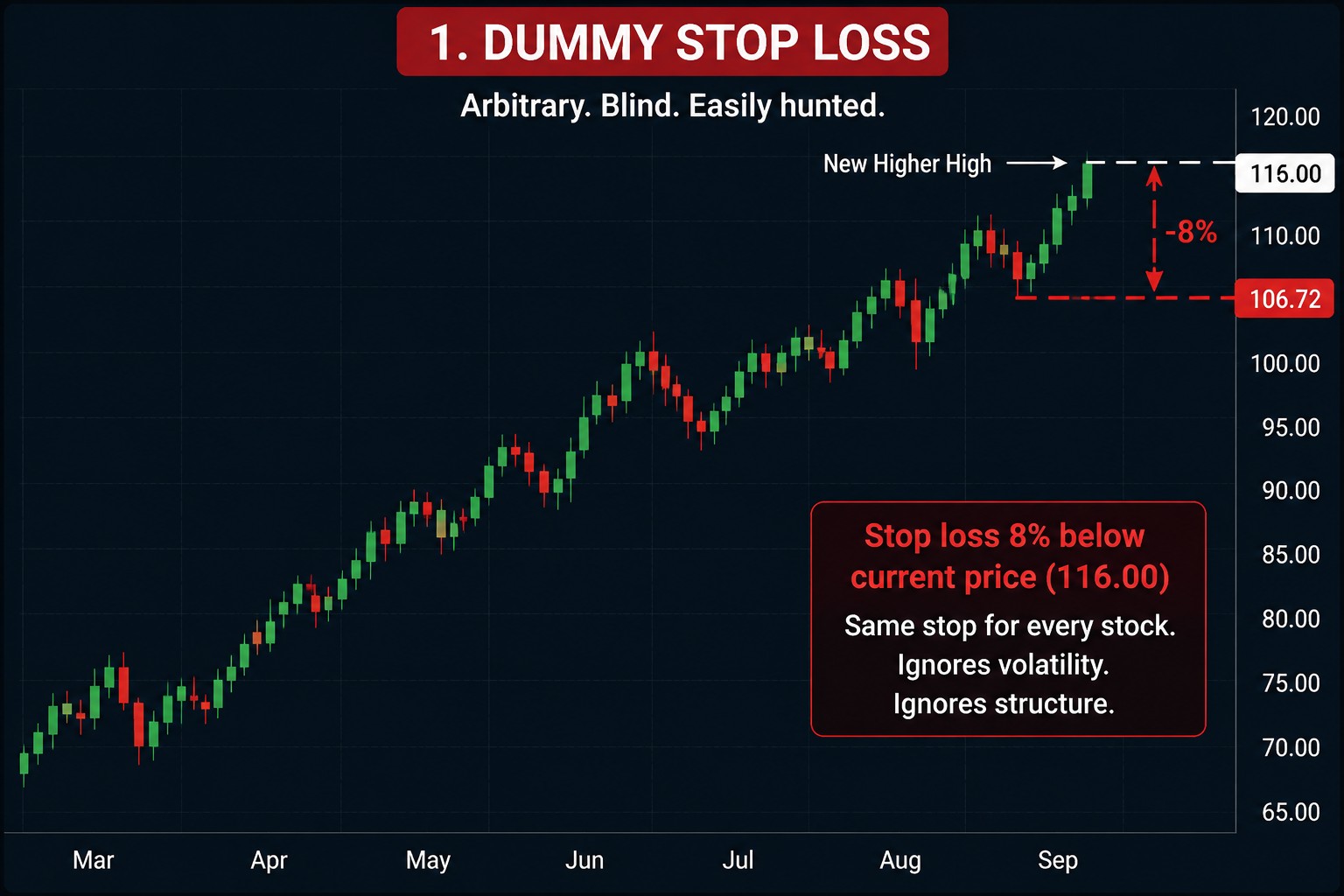
A dummy stop is an arbitrary number applied uniformly across every trade, most commonly a fixed percentage such as ten or fifteen percent below the purchase price, regardless of the stock, its volatility, or the chart. It is easy to implement, and it is also blind. A fixed percentage means almost nothing on a stock that regularly swings eight percent in a week, and it means far too much on a stable low-volatility name where that same move already signals something has genuinely broken.
Intelligent stops
An intelligent stop is derived from the security itself and/or context rather than imposed on it. Three layers are worth building, in increasing order of sophistication.
Structural or chart-based stops. A more discerning trader places the stop beneath a level that has actual meaning on the chart, a prior base, a broken resistance that should now act as support, or a key moving average such as the 50-day, the 150-day, or the 200-day line, chosen depending on the entry pattern. The logic is simple. If price falls back through the exact level that justified the trade, the original reason for owning the stock is no longer valid, and the position should be closed on its own merits rather than at an arbitrary distance.
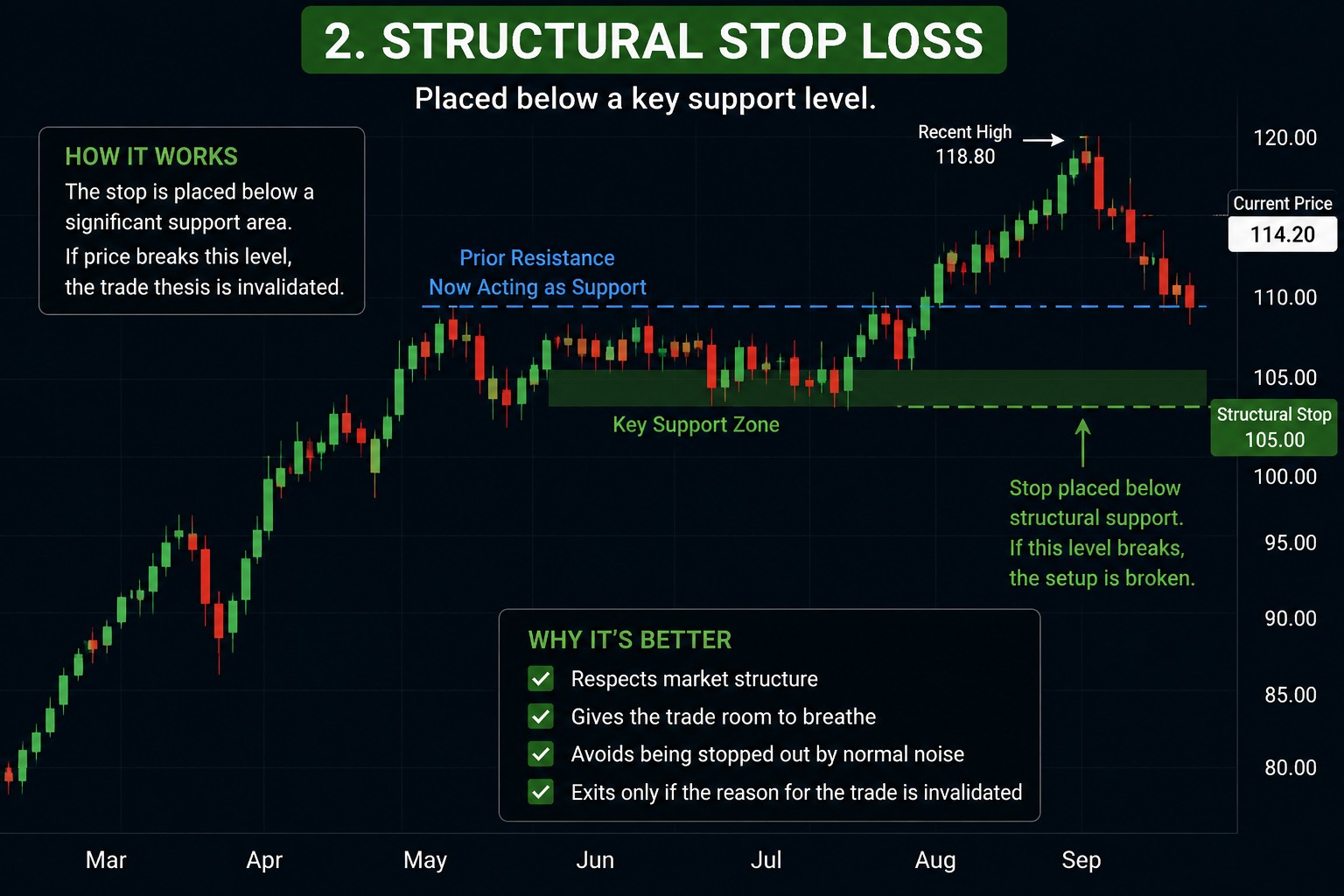
One objection worth answering directly is the claim that placing a stop at an obvious technical level is pointless because everyone else’s stop sits at the same price, and that level gets run before the real move happens. There is truth in it. Round numbers, prior lows, and textbook moving averages are exactly where liquidity clusters, and price can and sometimes does push through a crowded level before reversing. The correct response to that is not to abandon technical stops; it is to stop placing them exactly on the obvious number. A volatility buffer below the structural level, or the confirmation requirement described above, both exist specifically to avoid being the easy liquidity at a level everyone can see on the same chart.
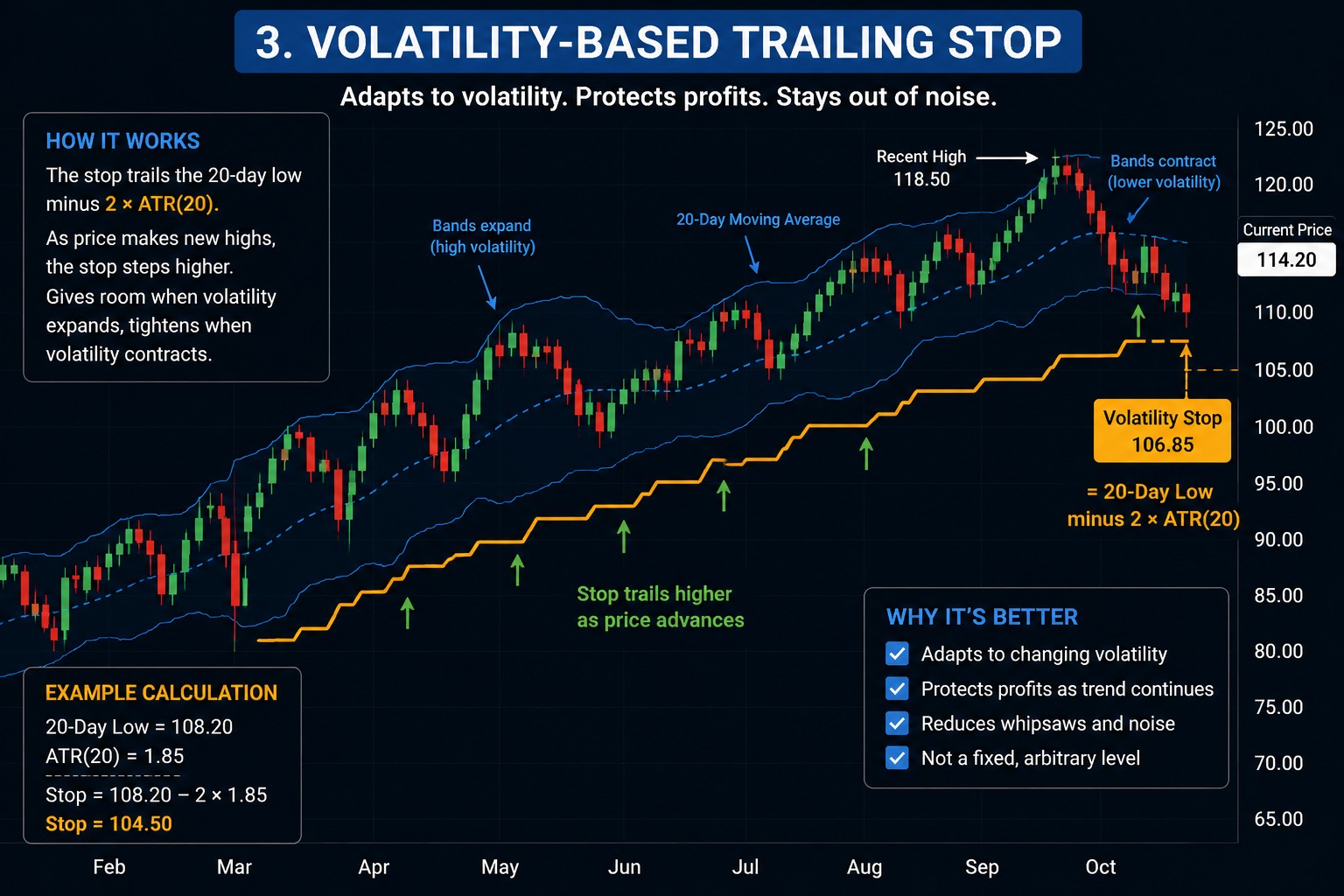
Volatility-based stops. Instead of a fixed percentage, the stop is set as a multiple of the stock’s own average true range or realized volatility, giving the best of both worlds, avoiding a premature exit on a normally noisy name while still keeping risk genuinely managed. A volatile name gets more room, a quiet name gets a tighter leash.
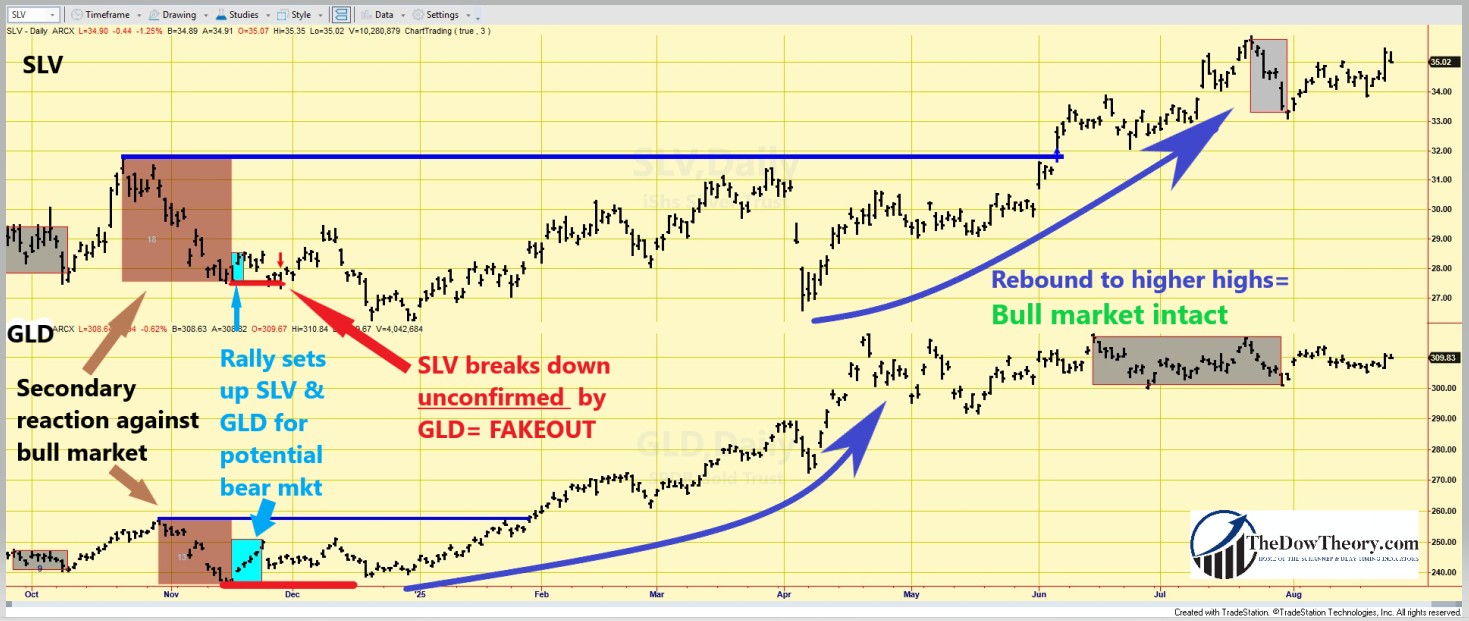
Confirmation-based stops. This is the most refined layer and the one closest to classical Dow Theory thinking. A single instrument breaking a significant technical level can be a fakeout, a stop run, or noise driven by low liquidity. Requiring confirmation from a related asset filters out a meaningful share of false signals. If the stock breaks its level but the related asset holds firm, the break is more likely noise. If the two assets break together, the signal is real, and the exit should follow without hesitation. This is the same principle that governs price and Advance Decline line confirmation in classical Dow Theory, applied here at the level of a single position’s exit rule.
The image below, whose full explanation you may find in this post, provides an excellent example of stops based on the principle of confirmation. The piercing of SLV (silver ETF) at a relevant low, unconfirmed by GLD (gold ETF), proved to be a fakeout.
The Third Path: The No Stop Fallacy For Day Traders
A different objection surfaces often in these threads: the claim that day traders do not need stops at all because closing every position before the close removes overnight gap risk entirely. This is true as far as it goes, and it is also close to the most unhelpful answer people give to the stop question, because it treats day trading as a fixed strategy rather than a capacity-constrained one.
A day trader working with a modest account is right that flattening at the close solves the gap problem, and there is nothing wrong with building a living around that approach. But day trading does not scale the way the argument implies. Executing meaningfully large size within a single session, without moving the price against yourself, becomes progressively harder as the deployed assets grow, because intraday liquidity in any single name is finite and a large order worked in a few hours leaves a visible footprint. The trader who is right to skip stops at a modest account size is not automatically right once that account reaches real scale, not because the logic about gaps changed, but because pure day trading stops being available at that size. Growing an account seriously eventually forces a longer time frame, and a longer time frame is exactly where the gap risk the argument dismissed comes back, along with the need for a genuine stop discipline.
Furthermore, day traders who trade without stop losses often overlook the fact that a stock can collapse dramatically even within a single trading session. If you run a highly concentrated portfolio, which is often the case with only three or four positions, a single stock falling 30% intraday can inflict catastrophic damage on your overall portfolio. In other words, the absence of overnight risk does not eliminate the need for risk management. Even over the course of a single day, concentrated positions can produce losses large enough to jeopardize an entire trading account.
The Weak Point Of Stop-Losses: The gap
If you trade a concentrated portfolio of a few stocks, the risk of one gapping down would be unbearable, rendering any stop-loss moot. This is a hidden risk for which there is no “standard” protection (unless you use puts or similar sophisticated hedging strategies). A stop-loss will not protect you against a stock that drops 60% overnight. The takeaway is clear: even if you are a technical trader for whom the stop-loss is a must, you must strive for a diversified portfolio.
I have a hard time understanding traders who brag about their “high conviction,” “focused” portfolio. In this game, the objective is survival. Survive, and performance will follow.
Choosing Your Path
The mistake to avoid is not picking the wrong philosophy; it is borrowing the confidence of one philosophy while practicing another. A concentrated breakout trader who refuses to use a stop because Renaissance did not use one is not being sophisticated; he is simply unprotected because he lacks the breadth of positions and the statistical edge that made the stopless approach survivable at scale. Equally, a diversified fundamental investor who panics into a tight mechanical stop on every position is importing a discipline built for a different game entirely.
The honest question to ask before every position is not, “What is my stop?” It is, which game am I playing, and does my protection actually match it?
Sincerely,
Manuel Blay
Editor of thedowtheory.com