

Key price levels to watch are revealed in this post
Overview: GLD and SLV underwent a secondary reaction against the primary bull market. The recent price action completed the setup for a potential bear market signal on 3/31/26. Please mind the word “potential”, which implies that the primary bull market remains in force.
General Remarks:
In this post, I elaborate extensively on the rationale behind employing two alternative definitions to evaluate secondary reactions.
SLV refers to the Silver ETF. More information about SLV can be found HERE.
GLD refers to the Gold ETF. More information about GLD can be found HERE.
A) Market situation if one appraises secondary reactions not bound by the three weeks and 1/3 retracement dogma
As I explained in this post, the trend was signaled as bullish on 4/2/24.
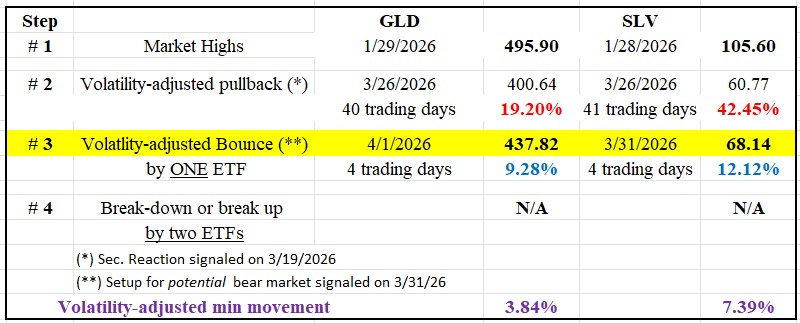
From the 1/28/26 and 1/29/26 closing highs for SLV and GLD, respectively, both declined into 3/26/26. This pullback met the time and extent requirements for a secondary (bearish) reaction against the primary bullish trend.
Following the 3/26/26 lows, there was a 4-day rally that exceeded the Volatility Adjusted Minimum Movement (VAMM) on GLD and SLV (more about the VAMM HERE).
The table below gives you the relevant dates and prices:
So, now there are two options:
- If SLV and GLD surpass their 1/28/26 and 1/29/26 highs on a closing basis, Step #1 in the above table, the secondary reaction and setup for a potential bear market signal will be canceled.
- A primary bear market will be signaled if SLV and GLD break down below their 3/26/26 low ( Step #2).
The charts below illustrate recent price movements. The brown rectangles highlight the secondary reaction within the primary bull market. The small blue rectangles on the right show the early days of a rally that set up both ETFs for a potential primary bear market signal. The blue horizontal lines indicate the last recorded primary bull market highs that must be surpassed to reconfirm the bull market (Step #1). The red horizontal lines highlight the 3/26/26 lows (Step #2).
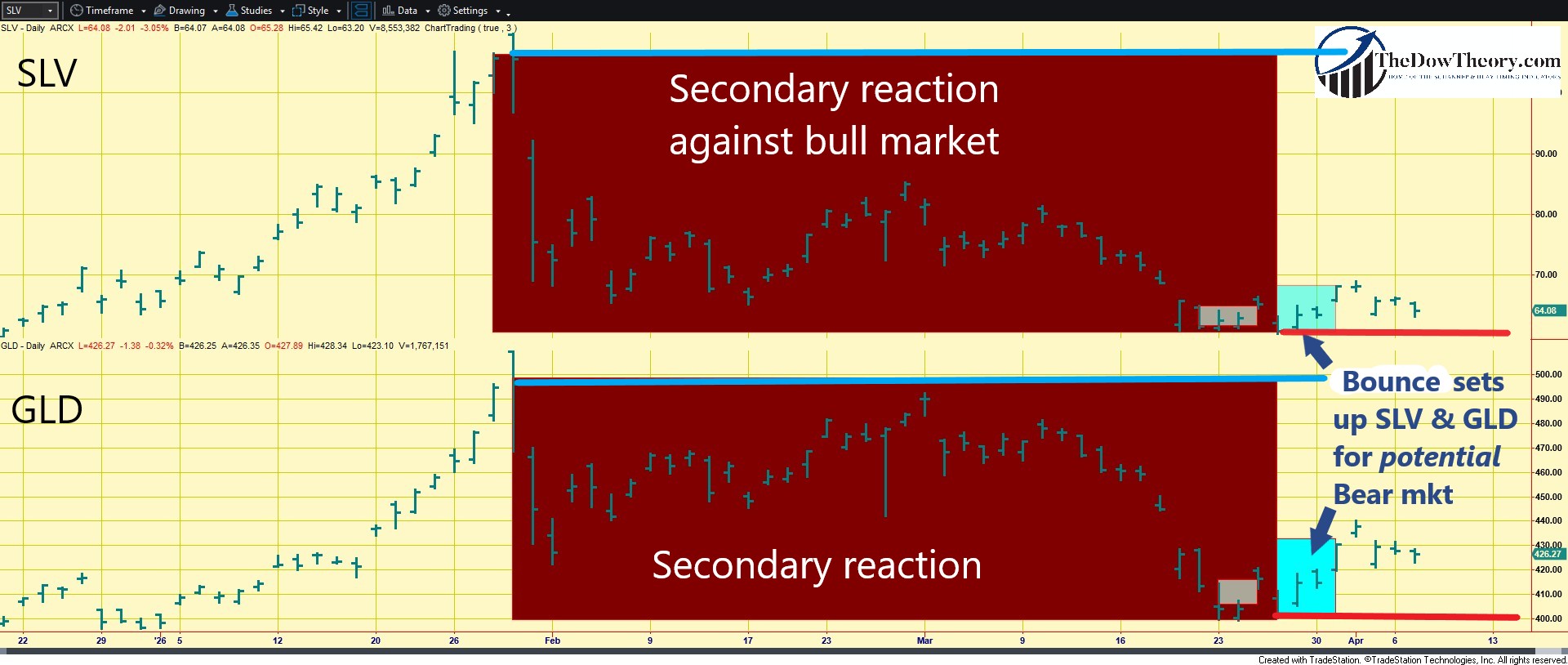
As of this writing, the primary trend is bullish, and the secondary one is bearish.
B) Market situation if one sticks to the traditional interpretation, demanding more than three weeks and 1/3 confirmed retracement to declare a secondary reaction
As I explained in this post, the trend was signaled as bullish on 4/2/24.
In this instance, the long-term application of the Dow Theory coincides with the shorter-term version, so there was a secondary reaction against the primary bull market, and the setup for a potential bear market signal has been completed.
As of this writing, the primary trend is bullish, and the secondary one is bearish.
Sincerely,
Manuel Blay
Editor of thedowtheory.com